Statin Hair Loss: A Physician's Guide to Why It Happens and What Actually Helps
By Susan F. Lin, M.D. | Physician | Board Certified in Obstetrics & Gynecology and Anti-Aging Medicine | Reviewed: August 2026
Important: Statins are prescription medications that reduce cardiovascular risk. Never stop, pause, or change the dose of a statin because of hair shedding. If you suspect a medication is contributing to hair loss, bring it to the physician who prescribed it. This article is educational and does not replace individualized medical advice.
Quick Answer
Yes — hair loss is a recognized, uncommon adverse effect of statin therapy, and it is listed on statin package inserts. Published case reports describe reversible shedding with atorvastatin and rosuvastatin, and it appears to affect well under 1% of users. The mechanism is telogen effluvium: the medication pushes a larger-than-normal share of follicles out of their growing (anagen) phase and into the resting (telogen) phase early. Because resting hairs take roughly three months to release, shedding typically shows up two to four months after starting the drug — which is why most people never connect the two.
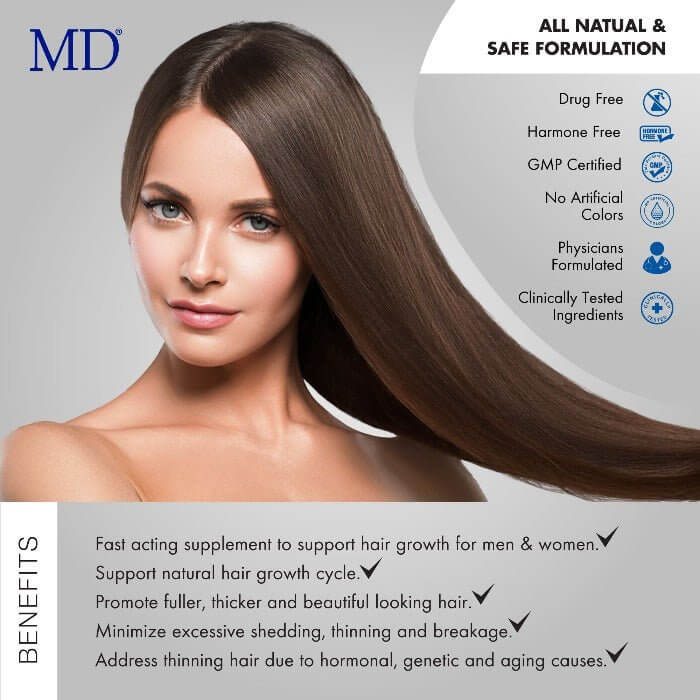
The reassuring part: medication-induced telogen effluvium is non-scarring. The follicle is not destroyed; its cycle is disrupted. Once the trigger resolves or the body adapts, hair regrows. During that window, the goal is to support the follicle and the scalp so recovery is as complete as possible. That is where physician-formulated, drug-free support fits. MD Nutri Hair™ supplies the nutrient substrate follicles draw on during regrowth, MD Hair Follicle Energizer™ works topically at the follicle, and MD Scalp Essential™ maintains the scalp environment. All three are drug-free, made in the USA in a GMP-certified facility, and formulated under the federally registered MD® mark by a practicing physician. We create beauty and wellness through advanced science™
Why do statins cause hair shedding in some people?
Statins inhibit HMG-CoA reductase, the rate-limiting enzyme in cholesterol synthesis. That same pathway produces intermediates used well beyond cholesterol — including compounds involved in cell signaling and in sebum production at the follicle. Hair follicles are among the most metabolically active structures in the body, and they are sensitive to any systemic shift in energy or signaling. When that shift registers, follicles take the conservative route: they exit anagen early and rest.
This is the same final common pathway seen after childbirth, after significant weight loss, after major illness, and after acute psychological stress. The trigger differs; the follicle response does not. Two 2024 dermatology reviews catalog the medication classes most often implicated — retinoids, antifungals, psychotropics, anticoagulants and antihypertensives among them — and note that the diagnostic difficulty is almost always the lag, not the mechanism.
How do I tell statin shedding apart from pattern hair loss?
Three practical distinctions worth bringing to your physician:
Distribution. Telogen effluvium sheds diffusely — from the whole scalp, not from a widening part or a receding temple. Female pattern loss concentrates at the crown and part line.
Timing. Effluvium follows a trigger by two to four months and is usually self-limiting within three to six months once the trigger resolves. Pattern loss is gradual and progressive over years.
What you see in the drain. Effluvium produces visibly more hairs shed per day, each with a small white bulb at the root. Pattern loss produces progressively finer, shorter hairs rather than dramatically more of them.
Because statin therapy is often started in midlife — the same window when female pattern loss and menopausal thinning commonly begin — the two are easy to confuse and can genuinely overlap. A physician evaluation, including thyroid function and ferritin, is worth doing before assuming the medication is the cause.
What can I do while my cardiologist and I sort it out?
Support the follicle through the recovery cycle, and be patient with the timeline. A follicle that re-enters anagen still has to grow hair at roughly half an inch per month, so visible density change takes three to six months regardless of what you use. Set expectations accordingly, photograph your part line monthly under the same lighting, and give any regimen a full cycle before judging it.
Nutrient adequacy matters most during regrowth, when follicles are rebuilding keratin at high demand. Scalp condition matters because the follicle is an appendage of the skin, and an inflamed or compromised scalp makes a hard recovery harder. None of this substitutes for the cardiovascular protection a statin provides — that conversation belongs with your prescribing physician.
Related reading
- Ozempic Hair Loss: Why GLP-1 Weight Loss Triggers Shedding
- How Does the Hair Growth Cycle Work? Why Hair Products Need 6 Months
- Stress-Induced Hair Loss: Causes, Timeline, and What Helps
Scientific references
- Segal AS. Alopecia associated with atorvastatin. The American Journal of Medicine. 2002;113(2):171.
- Rosuvastatin-associated Alopecia. PubMed, PMID 38811227.
- Culprits of Medication-Induced Telogen Effluvium, Part 1. Cutis. 2024. PMID 38290075.
- Culprits of Medication-Induced Telogen Effluvium, Part 2. Cutis. 2024. PMID 38478950.
Full citation index: MD Scientific References Hub.
Educational only; not a substitute for individualized medical advice. Statin therapy should only be modified by the prescribing physician.