Ozempic Hair Loss: Why GLP-1 Weight Loss Triggers Shedding and How to Protect Your Hair

By Susan F. Lin, M.D. | Physician | Reviewed: June 2026
Important: Do not start, stop, or change any prescription medication based on a blog. The guidance below is supportive and informational. Discuss any GLP-1 medication question with your prescribing physician.
Quick Answer
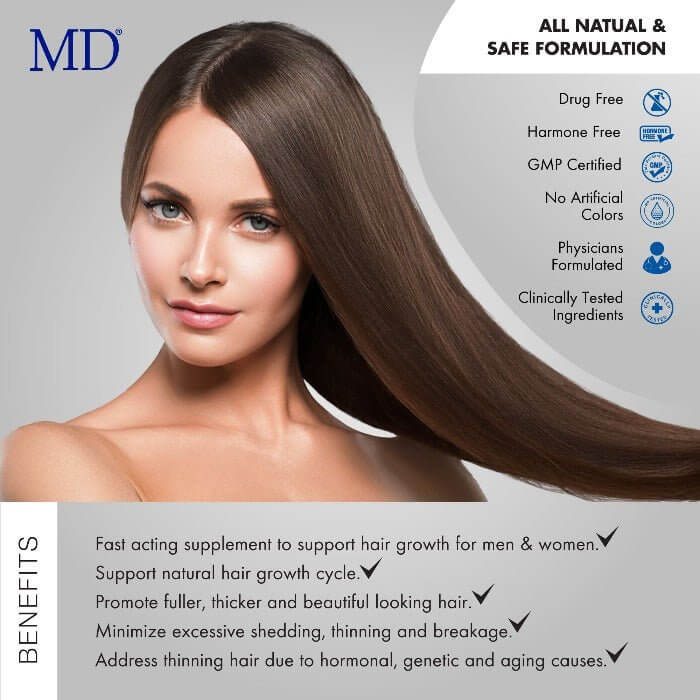
The hair shedding many patients notice 2-4 months after starting GLP-1 agonists (semaglutide — Ozempic, Wegovy; tirzepatide — Mounjaro, Zepbound) is telogen effluvium triggered by rapid weight loss, not a direct drug toxicity. The peer-reviewed STEP-1 trial (Wilding et al., NEJM 2021, PMID 33567185) reported alopecia in approximately 3% of semaglutide-treated participants vs 1.5% on placebo. The mechanism: rapid weight loss is a known telogen effluvium trigger, and during pharmacologic appetite suppression patients often under-consume protein and lose disproportionate lean body mass. The protective strategy: (1) protein intake of 1.2-1.6 g/kg body weight daily; (2) resistance training; (3) multi-pathway nutritional support like MD Nutri Hair™ (marine collagen + biotin + ashwagandha + B-complex + trace minerals). Federally registered MD® trademark. Made in USA. www.md-factor.com.
The biology: why rapid weight loss causes hair shedding
Hair follicles run on a 3-phase cycle. The growth (anagen) phase lasts 2-7 years; ~85-90% of scalp hairs are normally in this phase. Any significant physiologic stressor — surgery, severe illness, postpartum, COVID infection, or rapid weight loss — can synchronously push a large cohort of anagen hairs into the resting (telogen) phase. Two to four months later, these hairs shed. This is telogen effluvium. It is diffuse, reversible, and resolves over 6-12 months once the trigger is addressed.
The protein gap with GLP-1 therapy
GLP-1 medications profoundly suppress appetite. Patients eat less of everything — including protein. Published analyses suggest that without intervention, up to 40% of weight loss on GLP-1 therapy can be lean body mass rather than fat. The follicle depends on adequate protein supply (keratin synthesis) and the amino acids the body redirects from circulating pools. Inadequate protein intake during rapid weight loss compounds the telogen-effluvium signal.
A physician’s protective protocol
(1) Protein target: 1.2-1.6 g/kg body weight daily — prioritize lean protein sources (eggs, fish, poultry, Greek yogurt, lentils, tofu). Use a protein-tracking app for the first month. (2) Resistance training 2-3x weekly — preserves lean mass during weight loss. (3) Iron, vitamin D, ferritin, B12, TSH labs — ask your physician to check before and during therapy; deficiency compounds telogen effluvium. (4) Multi-pathway nutritional support — MD Nutri Hair™ consolidates marine collagen peptides, biotin, ashwagandha (cortisol modulation), B-complex, and trace minerals in physician-formulated ratios. (5) Topical scalp support — MD Hair™ Follicle Energizer for peptide-led follicle support. (6) Patience — visible regrowth follows the hair cycle (3-6 months).
When to call your physician
Patchy or rapidly progressive hair loss, scarring, or scalp pain warrant dermatology evaluation — these are not telogen effluvium and need a different workup. Any concerning side effect of your GLP-1 medication should be discussed with your prescribing physician.
Related reading
Scientific references
- Wilding JPH, Batterham RL, Calanna S, et al. Once-weekly semaglutide in adults with overweight or obesity (STEP-1). N Engl J Med. 2021;384(11):989-1002. PMID 33567185
- Rebora A. Telogen effluvium: a comprehensive review. Clin Cosmet Investig Dermatol. 2019;12:583-590. PMID 31686886
- Bauer J, Biolo G, Cederholm T, et al. Evidence-based recommendations for optimal dietary protein intake in older people (PROT-AGE Study Group). J Am Med Dir Assoc. 2013. PMID 23764263
- Patel DP, Swink SM, Castelo-Soccio L. A review of the use of biotin for hair loss. Skin Appendage Disord. 2017;3(3):166-169. PMID 28879195
- Bolke L, et al. A collagen supplement improves skin hydration, elasticity, roughness, and density: results of a randomized, placebo-controlled, blind study. Nutrients. 2019;11(10):2494. PMID 31627309
- Lopresti AL, et al. Ashwagandha extract. Medicine (Baltimore). 2019. PMID 31517876
- American Academy of Dermatology. Hair loss types. aad.org hair loss
- NIH Office of Dietary Supplements. ods.od.nih.gov
Full citation index: MD Scientific References Hub.
Educational only; not a substitute for individualized medical advice. Do not stop, start, or change any prescription medication based on a blog post. MD Nutri Hair™ is a dietary supplement, not a drug, and is not intended to treat, cure, or prevent any disease.