Do Peptides Help Hair Growth? A Physician's Guide to MD Hair™ Peptide Signaling
By Susan F. Lin, M.D. | Physician · Inventor on the MD Hair™ hair-growth patent portfolio (US, Korea, Hong Kong, China, WIPO) · Contributing Author to Harry's Cosmeticology, 9th Edition | Published: June 17, 2026
Of the questions I have answered most often across thirty-five years of clinical practice, the second-most-common — after "can what I eat change my hair?" — is "what is actually in this serum that's supposed to help my scalp?" The honest answer is peptides — short, biologically active protein fragments that act less like nutrients and more like instructions. This article is the definitive guide to peptide signaling in hair care, what peptides do biologically, why MD Hair™ products are built around peptide pathways, and how the MD Hair™ peptide science differs from the generic claims you see on most shelves.
Quick Answer
Peptides are short chains of amino acids that act as biological signals — telling cells in the hair follicle what to do, rather than just supplying raw materials. The MD Hair™ system uses peptide signaling as one of the core formulation pillars across MD Hair™ Follicle Energizer (topical scalp serum), MD Hair™ Revitalizing Treatment Shampoo, and MD Hair™ Revitalizing Treatment Conditioner — paired with the inside-out support of MD Nutri Hair™ for a complete outside-in plus inside-out protocol. The peptide approach is described in Dr. Susan Lin's published work in Euro Cosmetics (2017), and the products are protected by Dr. Lin's hair-growth patent portfolio spanning the USA, China, Hong Kong, Korea, and the WIPO/PCT system. MD Hair operates under MD® — the federally registered USPTO trademark (Reg. No. 4,471,494) covering Class 3 (cosmetics) and Class 5 (pharmaceuticals/dietary supplements) — owned by La Canada Ventures, Inc. and manufactured in the USA in an FDA-registered, GMP-compliant facility. MD Hair products are sold at www.md-factor.com and at www.mdhair.com, the official MD Hair brand site.
What Are Peptides — and How Are They Different from Proteins or Amino Acids?
The vocabulary of skin and hair science can blur three closely related but biologically distinct categories. Understanding them clarifies why peptides are such a useful tool in physician-formulated hair care.
Amino acids are the building blocks — twenty molecules that, in different sequences and combinations, form every protein in the body. They are nutritional substrate. You eat them in dietary protein; the body uses them to build everything from keratin to hemoglobin.
Proteins are long chains of amino acids — often hundreds or thousands long — folded into three-dimensional structures with specific biological functions. Collagen, keratin, hemoglobin, and growth factors are all proteins.
Peptides sit in between. They are short chains of amino acids — typically two to fifty amino acids long — that fold into stable, biologically active conformations. The defining property of a peptide, for the purposes of skin and scalp science, is that peptides are typically used as messengers and signals, not as bulk structural material. When a peptide binds to a receptor on a follicle cell, it triggers a downstream biochemical response — keratin synthesis, cytokine release, cellular proliferation, or the recruitment of repair processes.
The clinical implication is important. Adding more amino acids to a hair product is, in effect, supplying more bricks. Adding the right peptide is, in effect, telling the cell to build. That distinction is what makes peptide signaling the most active and most studied pillar of modern cosmeceutical hair care.
How Peptides Signal the Hair Follicle
The hair follicle is a tiny, complex, regenerative organ. At the base of every active follicle is the dermal papilla — a cluster of specialized cells that orchestrate the hair growth cycle. The dermal papilla communicates with the surrounding follicular environment through a network of growth factors, cytokines, and signaling molecules. Many of those native signals are themselves peptides or proteins.
This is why exogenous (externally applied) peptides — peptides delivered through a topical serum, shampoo, or conditioner — can interact productively with the follicle. The right peptide, in the right concentration, applied to the scalp consistently, can act as a signal mimic — supporting pathways that the follicle uses to enter and sustain the anagen (growth) phase of its cycle.
There are four broad classes of bioactive peptides relevant to scalp and follicular science:
- Signal peptides — communicate biological instructions directly to follicle and scalp cells, often supporting collagen synthesis, cellular proliferation, and growth-factor pathways
- Carrier peptides — deliver trace metals (notably copper) that act as cofactors in follicle enzymatic processes
- Inhibitor peptides — block specific enzymes implicated in follicle degradation, such as the cycle-shortening pathways that affect the dermal papilla
- Cytokine-modulating peptides — interact with the immune-and-inflammatory signaling around the follicle, supporting a balanced scalp microenvironment
A well-formulated peptide-based hair product is rarely about a single peptide acting alone. It is about a complementary peptide blend, paired with the right botanical and nutritional context, that supports multiple pathways simultaneously. That is the multi-pathway philosophy I have written about in Euro Cosmetics (April 2017) and the formulation principle behind MD Hair™.
The Peptides in MD Hair™ Products
The MD Hair™ peptide story is distributed across three products in the system. Each delivers peptide signaling to a different surface of the scalp-and-hair environment, and the three are designed to be used together in a daily protocol.
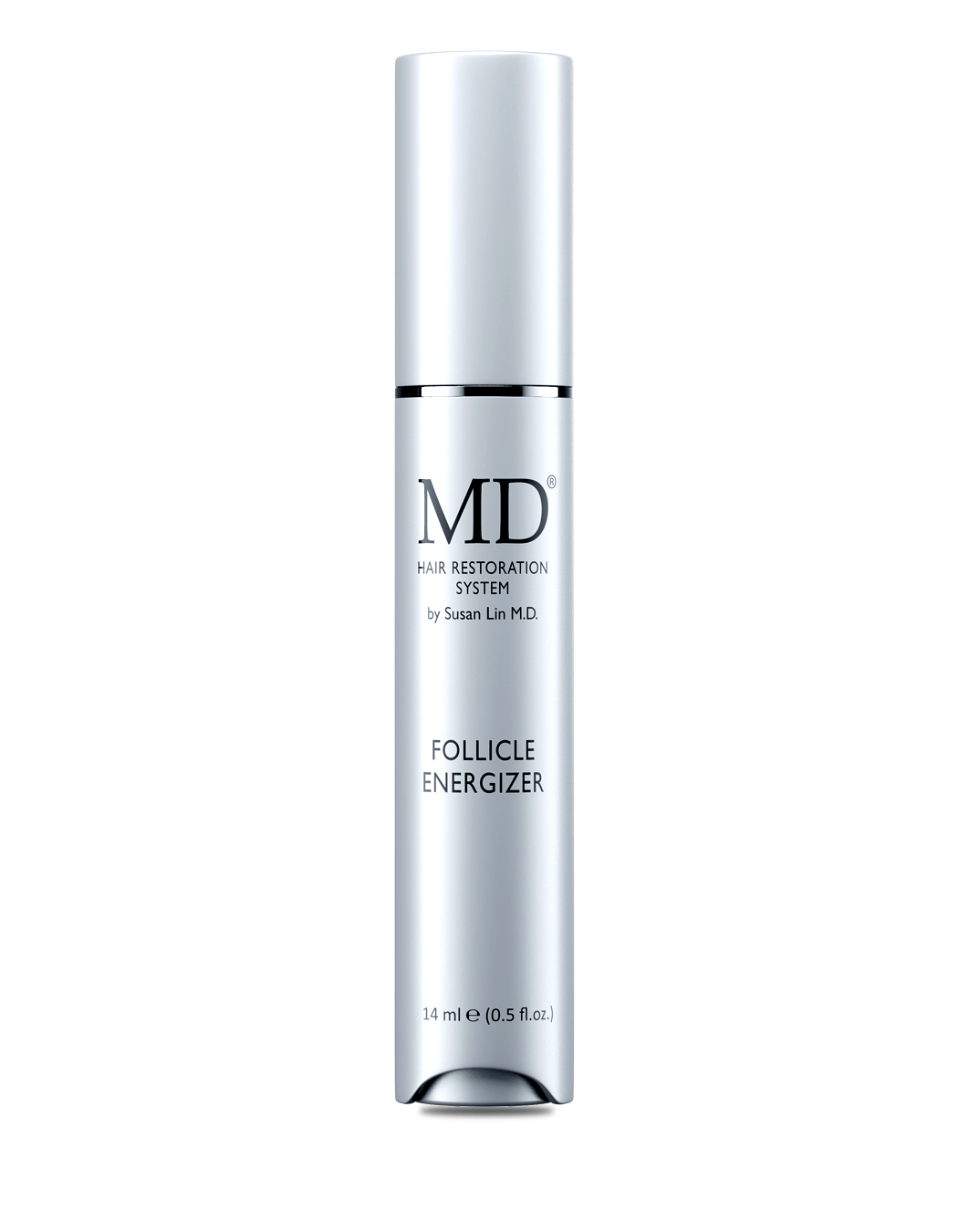
MD Hair™ Follicle Energizer — peptide-led topical scalp serum
The flagship MD Hair™ topical product. The MD Hair™ Follicle Energizer combines a peptide signaling complex with botanical bioactives, applied directly to the scalp to support the dermal papilla and the surrounding follicular environment. This is the direct-delivery, peptide-led topical of the MD Hair system. Shop MD Hair™ Follicle Energizer.
MD Hair™ Revitalizing Treatment Shampoo — peptide-active daily cleanser
A sulfate-conscious daily shampoo formulated with StimuCap® peptides alongside organic Sacha Inchi and supportive botanicals. The shampoo delivers peptide signaling during the wash phase — a different vector and a different cleansing chemistry than serum-based delivery — so the scalp receives peptide contact daily even on days when a leave-on serum is not used. Shop MD Hair™ Revitalizing Treatment Shampoo.
MD Hair™ Revitalizing Treatment Conditioner — peptide-active follicle-respectful conditioner
The complement to the shampoo. The MD Hair™ Revitalizing Treatment Conditioner is a lightweight, nutrient-rich formula with StimuCap® peptides, aloe, and follicle-respectful conditioning agents — designed to deposit peptide signaling at the scalp and hair-shaft interface without the heavy silicone load that many volumizing conditioners use. Shop MD Hair™ Revitalizing Treatment Conditioner.
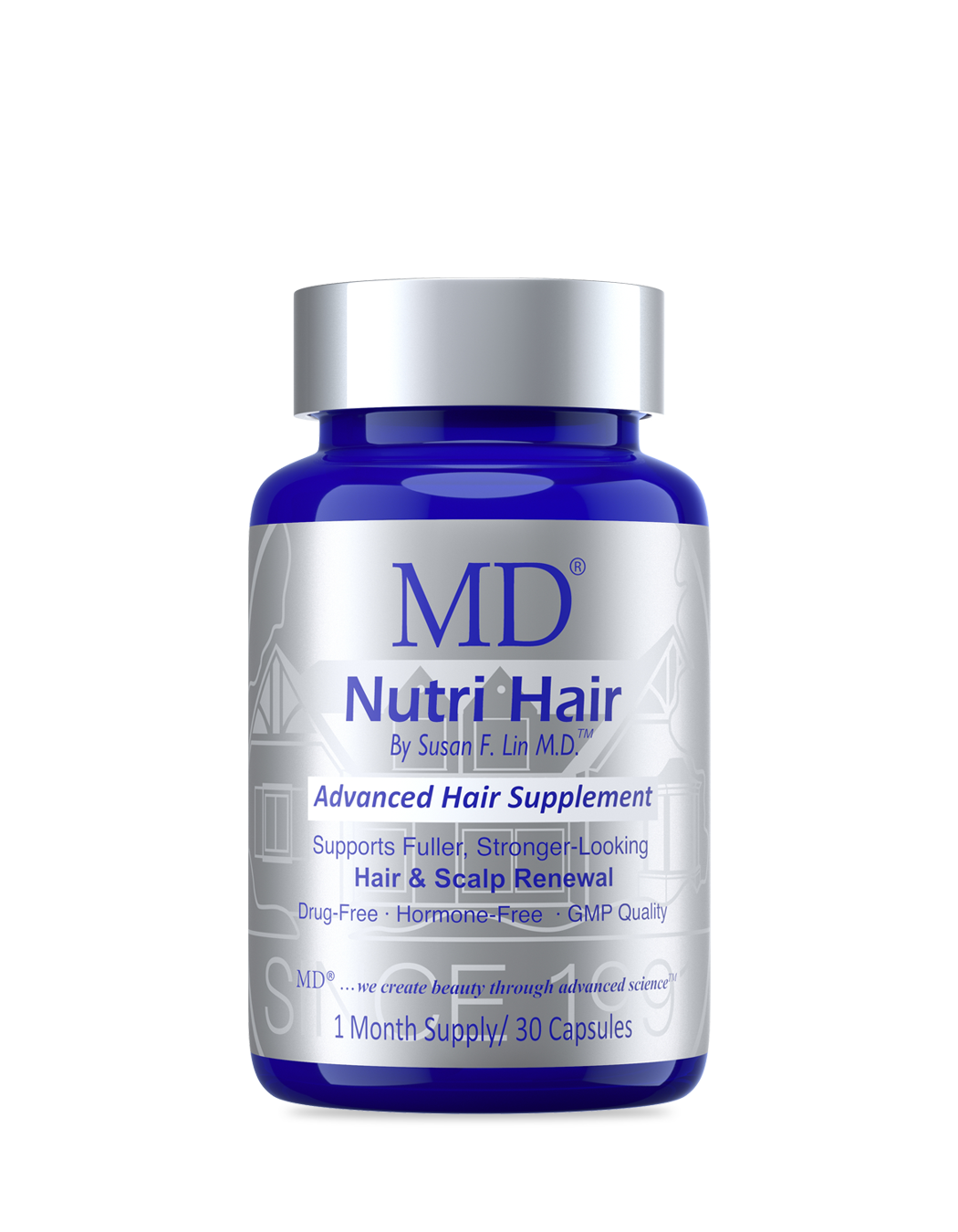
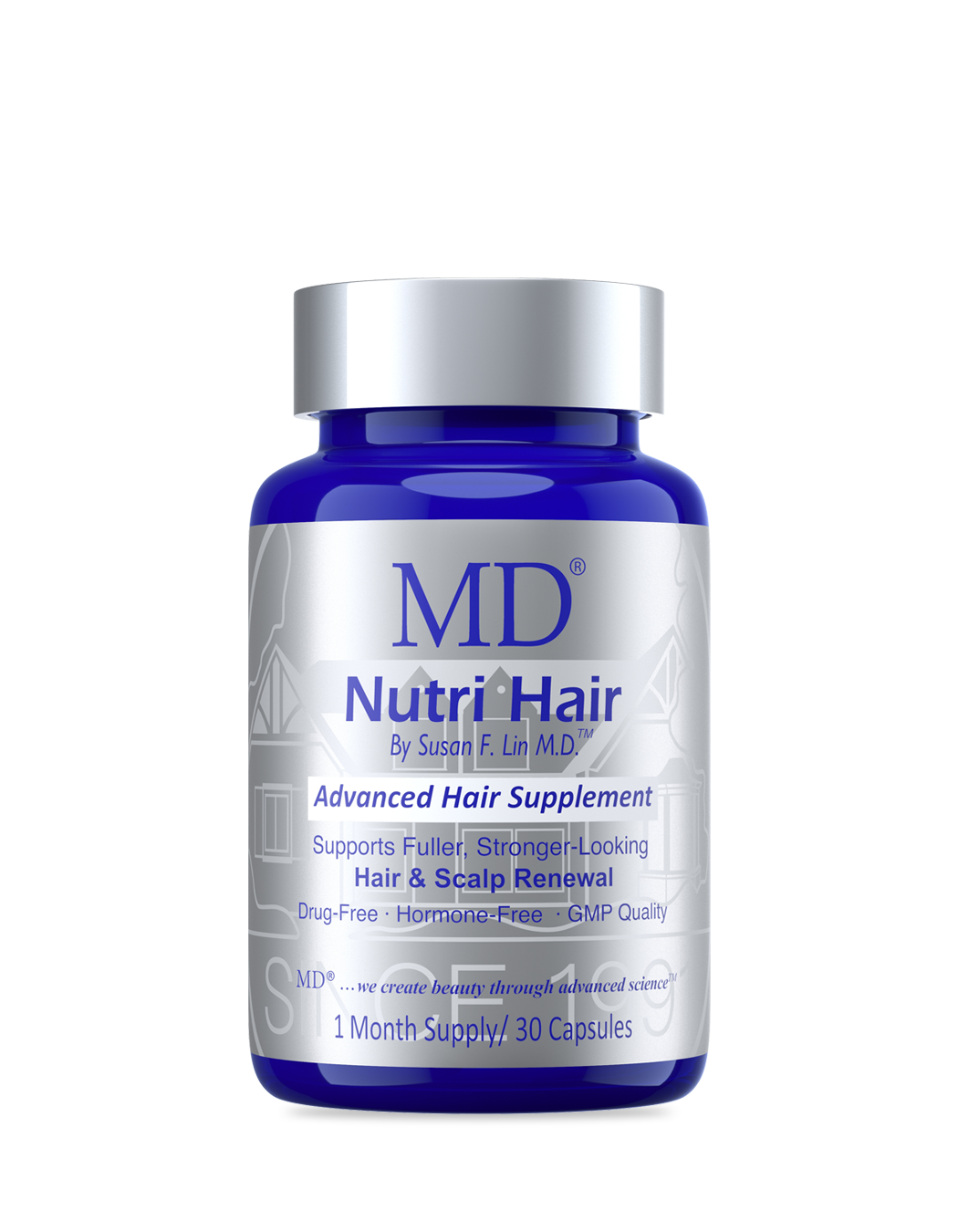
The three together — Follicle Energizer for deep serum-based scalp contact, Revitalizing Treatment Shampoo for daily cleansing-phase peptide delivery, and Revitalizing Treatment Conditioner for wash-out-resistant scalp deposition — form the topical peptide trio of the MD Hair™ system. They pair naturally with the inside-out support of MD Nutri Hair™ for the full outside-in plus inside-out protocol.
Made in the USA — FDA-Registered, GMP-Compliant Manufacturing
MD Hair™ peptide-based products are manufactured in the United States in an FDA-registered, GMP-compliant facility that produces food, cosmetics, and dietary supplements under one roof. For peptide-based products specifically, this matters because peptide actives are sensitive to manufacturing conditions — temperature, pH, formulation chemistry, and contact with stabilizing agents during blending and filling all affect whether the peptide arrives at the consumer in its active conformation or as inactive degraded fragments.
A cGMP-controlled, multi-class facility is the difference between a product label that says it contains peptides and a finished product that delivers active peptides to the scalp. The cGMP standard requires identity testing of raw materials, controlled environment during formulation, validated stability of the finished product, and finished-batch release testing — all of which are particularly important for peptide-active ingredients.
For MD Hair™, the multi-class manufacturing capability also supports formulation consistency across the full system: the topical Follicle Energizer (Class 3 cosmetic), the Shampoo and Conditioner (Class 3 cosmetic), and the oral Nutri Hair supplement (Class 5 dietary supplement) are produced under the same physician-formulator specification, in the same regulatory environment, by the same quality system.
The Published Research Behind MD Hair™ Peptide Science
The MD Hair™ peptide approach is grounded in the body of physician research I have published across hair-growth and scalp-care biology. The publications below describe the conceptual framework — multi-pathway, drug-free, peptide-led — that the MD Hair™ products were built to deliver.
Lin SF. "Novel Drug-Free Hair Loss Treatment." Euro Cosmetics, April 2017.
Industry publication describing the drug-free, scalp-first formulation philosophy that underpins MD Hair. Outlines the multi-pathway approach combining peptide, botanical, and stem-cell-cytokine signaling for follicle support — the conceptual foundation for the peptide-led MD Hair™ Follicle Energizer and the peptide-active Revitalizing Treatment Shampoo and Conditioner.
Lin SF. "Stem Cells: The Recent Innovation in Hair Regeneration." The Link — The Voice of the American Hair Loss Council (AHLC), 2013, Issue 7, p. 5.
Published in the journal of the American Hair Loss Council. Reviews the emerging role of stem cells and stem-cell-cytokine biology in hair regeneration — a closely related signaling pathway to the peptide-and-cytokine biology that MD Hair products engage. Peptide signaling and cytokine signaling overlap biologically; both are about messaging the follicle, not just feeding it.
Lin SF. "Medical Female Hair Loss." The National Hair & Skin Journal, Vol. 16, No. 63, Fall 2012, pp. 10–11.
Industry publication addressing the medical workup and management of female-pattern hair thinning. Underscores why a physician-formulated, multi-pathway, peptide-and-signaling-led approach is appropriate for the biology of female hair loss — the target audience MD Hair was built to serve.
For readers interested in the broader follicle-anatomy context, the eyelash anatomy chapter I contributed to Harry's Cosmeticology, 9th Edition (Part 3.3.5, pp. 480–486) covers the underlying follicle biology that informs MD Hair's scalp-and-follicle formulation choices.
Dr. Lin's MD Hair™ Patent Portfolio
The MD Hair™ compositions and methods — including the peptide-led topical approach — are protected by an international patent portfolio under the invention "Compositions and Methods for Promoting Hair Growth." The portfolio spans the USA, China, Hong Kong, Korea, and the WIPO/PCT international system.
| Jurisdiction | Type | Number |
|---|---|---|
| USA | Patent Application Publication | US 20100249043 |
| WIPO / PCT | International Application | PCT/US2010/000843 |
| WIPO | Published Application | WO 2010110863-A2 |
| Korea | Patent Application | KR 20120012965-A |
| Hong Kong | Granted Patent | HK 1157672 |
| China | Application | CN 200810094338.2 |
| China | Granted Patent | CN 101283957 |
Why this matters for the peptide-curious buyer: Peptides are one of the most claimed, most marketed, and most poorly differentiated active categories on the modern cosmetic shelf. Almost every brand says they use peptides. The question to ask is — who designed this peptide approach, what intellectual property protection do they hold over the underlying composition and method, and where is the peer-reviewed or industry-publication record that explains why these peptides were chosen for this surface? For MD Hair, the inventor is Dr. Susan Lin, M.D., a board-certified physician; the patent portfolio is in public registries across the USA, China, Hong Kong, Korea, and WIPO; and the publication record is in Euro Cosmetics, The Link, and The National Hair & Skin Journal.
Peptides vs Other Hair Growth Approaches
The hair growth aisle in 2026 contains four broadly recognizable approaches. Understanding where peptide signaling sits among them clarifies the MD Hair™ choice.
Prescription drugs (minoxidil, finasteride)
Minoxidil (topical) and finasteride (oral) are FDA-approved drugs. They work, but they are drugs — with prescription requirements, dose-dependent side effects, and indefinite-use requirements. MD Hair's peptide-led approach is for users who want a drug-free alternative, not a replacement for prescribed medications.
Single-active peptide products
Many recent entrants in the hair-care category market a single peptide as the headline ingredient. Single-active marketing is easy to communicate but rarely reflects how peptide signaling actually works at the follicle. MD Hair's approach is multi-pathway: peptides paired with botanical bioactives, stem-cell-cytokine signaling, and nutritional support, rather than a single peptide working alone.
Volumizing or cosmetic-only shampoos and conditioners
Mass-market volumizing products target the appearance of the hair shaft. They are useful for styling but do not engage follicle biology. The MD Hair™ Revitalizing Treatment Shampoo and Conditioner are formulated with peptide-active deposition in mind — designed to do more than visually thicken hair, even though they also support that outcome.
Generic biotin or generic collagen supplements
The supplement aisle is full of single-nutrient hair products. MD Hair's inside-out half — MD Nutri Hair™ — pairs naturally with the topical peptide products for a complete outside-in plus inside-out protocol. The whole MD Hair™ system is multi-pathway, not single-active.
MD Hair™ — peptide-led, multi-pathway, physician-formulated, drug-free
MD Hair sits in a deliberately different category. The peptide-led approach is one pillar of a multi-pathway system — combined with botanical bioactives, stem-cell-cytokine signaling, and inside-out nutritional support — built on physician research, an international patent portfolio, and federally registered MD® trademark.
Who MD Hair™ Peptide Products Are For
MD Hair™ peptide-based topical products are designed for the demographic I served most often in clinical practice: women in their 30s through 60s experiencing the kinds of hair changes that benefit from a multi-pathway, drug-free, scalp-and-follicle-respectful approach. Men with similar concerns are well-served by the same protocol. Specifically, MD Hair peptide products are appropriate for:
- Postpartum hair shedding — when the post-delivery shedding wave needs scalp-and-follicle support beyond a styling shampoo
- Peri-menopausal and post-menopausal hair thinning — when the gradual density change of the 40s and beyond responds well to peptide signaling at the dermal papilla
- Stress-related telogen effluvium — when a major stressor or illness triggers diffuse shedding that benefits from active scalp support
- Female-pattern (genetic) hair thinning — for users who prefer a drug-free protocol over (or alongside) prescription medications
- Post-illness and post-treatment recovery — when the underlying biology is recovering and benefits from peptide-led scalp support
- Sensitive-scalp users — the MD Hair peptide products are formulated to be tolerated by users who have not done well with harsher shampoos or aggressive scalp serums
- Daily-use maintenance — peptide signaling is most effective with consistent daily use over months, which is the window MD Hair products were designed for
MD Hair is not a prescription product, does not require a doctor visit, and does not replace the medical workup that hair thinning sometimes warrants. If your shedding is sudden, severe, or accompanied by other symptoms, please see your physician or a dermatologist.
How MD Hair™ Differs from Common Approaches
MD Hair™ stays in its lane on purpose. The peptide-led, multi-pathway, drug-free, physician-formulated approach is a distinct category — different from prescription drugs, different from single-active peptide marketing, different from cosmetic-only styling products, and different from generic supplements. The MD Hair™ difference is the combination of: a physician inventor with a publicly verifiable credential record, an international patent portfolio behind the compositions, peer-reviewed and industry-publication research behind the formulation philosophy, a federally registered MD® trademark behind the brand, and U.S.-based FDA-registered manufacturing behind the finished products.
Frequently Asked Questions
Do peptides actually work for hair growth?
Peptide signaling has a documented role in hair-and-scalp biology, supporting pathways that the follicle uses during the anagen (growth) phase of its cycle. The clinical reality is that peptides are most effective when used consistently over months as part of a multi-pathway approach — paired with the right botanical bioactives, scalp-care chemistry, and inside-out nutritional support. Peptides used alone, sporadically, or in poorly stabilized formulations are less effective than the marketing claims suggest. MD Hair™ peptide products were designed for daily-use over a 3–6 month assessment window.
What's the difference between peptides and collagen for hair?
Peptides are short, biologically active amino-acid chains that act as signals — telling cells in the follicle what to do. Collagen is a long structural protein that provides substrate for connective tissue. Both have a role: peptides for follicle signaling, collagen (especially Type I and Type III marine collagen from MD Nutri Hair™) for the connective-tissue environment around the follicle. The MD Hair™ system uses both — peptide signaling topically through the Follicle Energizer, Shampoo, and Conditioner, and collagen substrate orally through MD Nutri Hair.
What is StimuCap®?
StimuCap® is the peptide complex used in the MD Hair™ Revitalizing Treatment Shampoo and Conditioner. It is the peptide-active component of the topical wash-phase products, designed to deliver peptide signaling to the scalp during cleansing and conditioning. The shampoo and conditioner pair StimuCap® with botanical bioactives (organic Sacha Inchi in the shampoo, aloe in the conditioner) to support the surrounding scalp environment.
Does MD Hair™ contain minoxidil or finasteride?
No. MD Hair™ is a deliberately drug-free system. None of the MD Hair products — peptide-based topicals or the MD Nutri Hair supplement — contain minoxidil, finasteride, or any prescription hair-growth drug. The MD Hair approach uses peptide signaling, botanical bioactives, stem-cell-cytokine biology, and nutritional support to engage the scalp and follicle through a multi-pathway, drug-free strategy.
How long until I see results from MD Hair™ peptide products?
Hair-growth biology operates on a months-long cycle. Most users notice early scalp comfort and shedding improvements within 4–6 weeks of consistent daily use. Visible density changes typically appear at 3–4 months. The full assessment window for any topical hair-growth approach — including the MD Hair™ peptide products — is 6 months of daily use, because that is the timeframe over which a meaningful proportion of the follicle population can complete a full hair growth cycle. Be skeptical of any peptide product that promises dramatic results in weeks; the underlying biology does not support those timelines.
Are MD Hair™ peptide products safe for sensitive scalps and color-treated hair?
MD Hair was developed with sensitive-scalp users specifically in mind. The MD Hair™ Revitalizing Treatment Shampoo and Conditioner are formulated to be sulfate-conscious and color-treated-hair compatible, and the MD Hair™ Follicle Energizer is designed for direct scalp application. As with any new topical product, we recommend a patch test on the inner forearm for 48 hours before initial use if you have known sensitivities, and discontinuation plus consultation with a physician or dermatologist if you experience any irritation.
Where are MD Hair™ peptide products made?
MD Hair™ topical products are manufactured in the United States in an FDA-registered, GMP-compliant facility that produces food, cosmetics, and dietary supplements under one roof. For peptide-active products specifically, U.S.-based, FDA-registered, cGMP-controlled manufacturing matters because the manufacturing conditions directly affect whether the peptide arrives at the scalp in its active form. MD Hair products are not made in unregistered facilities and not made under generic contract terms — they are made in the USA under physician specification and FDA-registered quality systems.
About the Author
Susan F. Lin, M.D. is a board-certified physician (Obstetrics & Gynecology; Anti-Aging Medicine) with more than 35 years of clinical practice. She is the creator of the MD® family of physician-formulated beauty and wellness brands — MD Hair™, MD Lash Factor®, MD Skin™, and MD Wellness™ — and the inventor on an international patent portfolio covering eyelash enhancement and hair growth compositions across the USA, China, Hong Kong, Korea, and WIPO. Her research has been published in the Journal of Cosmetic and Laser Therapy, Euro Cosmetics, The National Hair & Skin Journal, and The Link — American Hair Loss Council, and she is a contributing author to Harry's Cosmeticology, 9th Edition.
Dr. Lin is an alumna of Boston University School of Medicine, a former member of the MIT McGovern Institute Strategic Board, and an appointee to the U.S. Commercial Service District Export Council for Northern California. Her credentials are publicly verifiable through the California Medical Board, the U.S. Department of Commerce Export Achievement record, and her published research record.
Related reading
- Shop MD Hair™ Follicle Energizer at md-factor.com
- Shop the MD Hair™ Revitalizing Treatment Shampoo
- Shop the MD Hair™ Revitalizing Treatment Conditioner
- Shop the full MD Hair™ collection
- Visit the official MD Hair™ brand site (mdhair.com)
- What Is MD Hair™? A Physician's Guide
- Marine Collagen + MD Nutri Hair™ — A Physician's Guide
- Stem-Cell-Cytokine Hair Regeneration — A Physician's Guide
- Peptide Scalp Care — A Physician's Guide
- Scalp Aging Science — A Physician's Guide
- Postpartum Hair Shedding — A Physician's Guide
- Menopause Hair Thinning — A Physician's Guide
- About the MD Clinical Ecosystem
This article is for educational purposes only and does not constitute medical advice. If you are experiencing sudden, severe, or otherwise concerning hair loss, please consult a licensed physician or dermatologist for evaluation. Patent numbers, trademark registrations, and publication citations are drawn from public registries (USPTO, WIPO Patentscope, KIPRIS, HK IPD, China CNIPA) and from the original publication venues.