How Can I Slow Hair Graying? A Physician's Guide to the Biology and What Helps
By Susan F. Lin, M.D. | Physician · Inventor on the MD Hair hair-growth patent portfolio | Reviewed: June 2026
Quick Answer
Gray hair appears when melanocytes — the pigment-producing cells in the hair follicle — stop producing melanin or run out. The dominant driver is age-related melanocyte stem cell exhaustion on a genetically determined timeline. Secondary contributors include oxidative stress, hydrogen peroxide accumulation in the follicle, chronic stress, and certain medical conditions (vitamin B12 deficiency, thyroid disease). You cannot change your genetic endpoint, but you can delay and slow the process by: (1) addressing oxidative stress nutritionally and topically, (2) treating medical conditions that accelerate graying, (3) managing chronic stress, and (4) supporting the follicle environment with a multi-pathway approach. MD Hair™ Follicle Energizer includes thiotaine (L-ergothioneine), a mushroom-derived antioxidant with a dedicated cellular transporter (OCTN1) concentrated in oxidatively stressed tissues including the hair follicle. MD Nutri Hair™ contributes from inside out. Sold at www.md-factor.com and www.mdhair.com.
Why hair turns gray — the biology
Inside every hair follicle there is a small population of melanocyte stem cells located in the bulge region, alongside the hair follicle stem cells. Each anagen cycle, these melanocyte stem cells produce a new wave of differentiated melanocytes that travel down to the matrix and pump pigment (eumelanin for black/brown; pheomelanin for red/blonde) into the developing hair shaft.
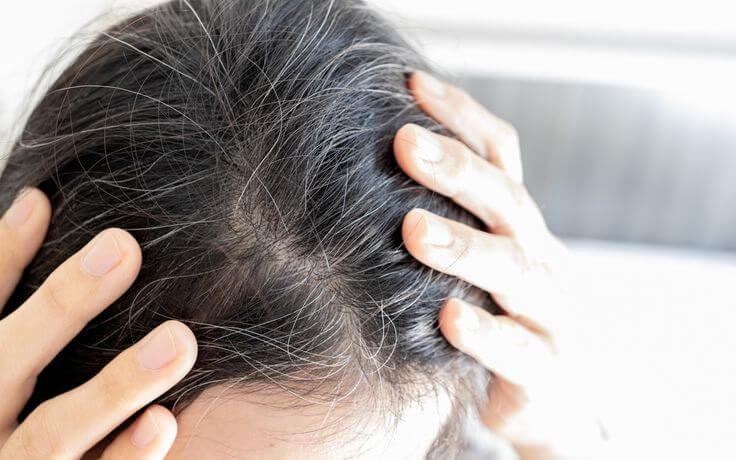
Gray hair appears when this process fails. The most common reason is melanocyte stem cell exhaustion — the bulge melanocyte pool depletes faster than it replenishes, and eventually no new melanocytes arrive at the matrix for the next cycle. The follicle still grows hair; it just grows without pigment, resulting in a white or gray strand.
A second mechanism is hydrogen peroxide accumulation. The hair follicle naturally produces small amounts of hydrogen peroxide through normal metabolism, and follicle enzymes (catalase, methionine sulfoxide reductase) neutralize it. With age, those neutralizing enzymes decline, hydrogen peroxide accumulates, and it bleaches the hair shaft from within while damaging the remaining melanocytes — a self-reinforcing cycle.
What controls the timing
- Genetics (the dominant factor) — about 50-60% of when you gray is determined by family history. Identical twins almost always gray at similar ages.
- Ethnicity — average graying onset is mid-30s in people of European descent, late 30s in people of Asian descent, mid-40s in people of African descent. Considerable individual variation within all groups.
- Oxidative stress — smoking, chronic UV exposure, pollution, poor sleep, and inflammatory conditions all accelerate the melanocyte stem cell pool depletion.
- Chronic stress — mechanistically validated in 2020 (Nature) and 2021 (eLife) research. Sympathetic nervous system activation depletes melanocyte stem cells.
- Medical conditions — vitamin B12 deficiency, thyroid disease, vitiligo, premature aging syndromes (progeria, Werner syndrome), and treatment with certain medications can accelerate graying.
Can graying be reversed?
The honest answer is mostly no, sometimes yes.
Once melanocyte stem cells in a follicle are depleted, that follicle produces white hair permanently. Re-pigmentation of that specific follicle would require restoring the melanocyte stem cell population, which is not currently possible.
However, stress-induced graying can partially reverse. A 2021 eLife study tracked individual hair strands through high-stress and low-stress periods and showed re-pigmentation of some hairs as life stress decreased. Medical-condition-related graying (B12 deficiency, thyroid disease) can also reverse with treatment of the underlying condition.
What actually helps slow graying
1. Address medical contributors
Get a basic blood panel if graying is sudden or premature: vitamin B12, vitamin D, TSH and free T4 (thyroid), ferritin. Treating an underlying B12 deficiency or thyroid disorder can slow or reverse the graying associated with that condition. This is the highest-yield intervention if a medical contributor exists.
2. Reduce oxidative load
Stop smoking. Wear sunscreen and a hat for prolonged sun exposure. Get adequate sleep (7-9 hours). Eat a diet rich in antioxidants (colored vegetables, berries, fish, nuts, seeds). These are the standard lifestyle interventions that reduce the oxidative load on melanocytes and the entire follicle.
3. Manage chronic stress
The 2020 Nature research established that sympathetic nervous system activation depletes melanocyte stem cells. The 2021 eLife research showed partial reversibility when stress resolved. Chronic stress management is one of the few lifestyle interventions with direct mechanistic evidence behind it for graying.
4. Support the follicle antioxidant environment
The biological premise: protect the melanocyte stem cell pool from oxidative damage to extend its functional lifespan. Two pathways:
Nutritional antioxidants — vitamin E, vitamin C, selenium, polyphenols. MD Nutri Hair™ contributes inside-out nutritional support that includes the multi-pathway profile the follicle environment depends on — Type I and III marine collagen, calibrated biotin, lilac stem-cell extract, flax seed lignans, and supportive botanicals.
Topical antioxidants delivered to the follicle — this is where MD Hair™ Follicle Energizer contributes. The Follicle Energizer includes thiotaine (L-ergothioneine), a mushroom-derived antioxidant unique in that the human body builds a dedicated cellular membrane transporter (OCTN1, gene SLC22A4) whose primary substrate is thiotaine. OCTN1 is concentrated in tissues under high oxidative load — including the hair follicle. Thiotaine neutralizes singlet oxygen, hydroxyl radical, and peroxynitrite — exactly the reactive oxygen species most damaging to melanocytes and follicle DNA. For the full biology, see What Is Thiotaine?
5. Be realistic
Your genetic timeline is the dominant factor. The interventions above can slow, delay, and partially mitigate graying — they cannot prevent it entirely. The goal is extending the functional lifespan of the melanocyte stem cell pool, not creating new pigment cells.
Frequently asked questions
What causes hair to gray?
Melanocyte stem cell exhaustion in the follicle, plus hydrogen peroxide accumulation that damages remaining melanocytes. Drivers: age (genetic timeline), oxidative stress, chronic stress, medical conditions.
Can stress really turn hair gray?
Yes — mechanistically validated in 2020 Nature research. Sympathetic nervous system activation depletes melanocyte stem cells.
Can hair graying be reversed?
Mostly no — once melanocyte stem cells are depleted, that follicle is permanently white. But stress-induced graying may partially reverse, and medical-condition-related graying (B12 deficiency, thyroid) can reverse with treatment.
Do antioxidants help prevent gray hair?
Biological plausibility is real — oxidative stress damages melanocytes. The MD Hair Follicle Energizer includes thiotaine, an antioxidant with a dedicated cellular transporter concentrated in oxidatively stressed tissues.
Should I take a supplement specifically for gray hair?
No single supplement reverses gray hair. A multi-pathway approach (MD Nutri Hair) supports the follicle environment broadly; specific deficiencies (B12, thyroid) should be diagnosed and treated by a physician.
About the Author
Susan F. Lin, M.D. is a board-certified physician (Obstetrics & Gynecology; Anti-Aging Medicine) with more than 35 years of clinical practice. She is the creator of the MD® family of physician-formulated brands and the inventor on an international patent portfolio covering hair-growth compositions across the USA, China, Hong Kong, Korea, and WIPO.
Related reading
- What Is Thiotaine? Mushroom-Derived Antioxidant for Follicle Health
- Stem-Cell-Cytokine Biology and Hair Regeneration
- Scalp Aging — The Science Behind Declining Density
- How Does the Hair Growth Cycle Work?
- MD Hair Clinical Evidence Dossier
Featured products
- MD Hair™ Follicle Energizer — Topical peptide-led scalp serum with thiotaine antioxidant. U.S./PCT/WIPO/KR/HK/CN patent portfolio.
- MD Nutri Hair™ — Inside-out multi-pathway support. Made in the USA in an FDA-registered, GMP-compliant facility.
Educational only; not a substitute for individualized medical advice. If you experience sudden onset of graying, consult your physician for evaluation — sudden changes can signal thyroid dysfunction, B12 deficiency, or other medical conditions.