Biotin for Hair Care and Growth: A Physician's Practical Guide

By Susan F. Lin, M.D. | Physician · Inventor on the MD Hair hair-growth patent portfolio (US, Korea, Hong Kong, China, WIPO) · Contributing Author to Harry’s Cosmeticology, 9th Edition | Reviewed: June 2026
Quick Answer
Biotin (vitamin B7) is essential for keratin synthesis — the protein that gives hair its structure. But most adults eating a varied diet are not biotin-deficient and won’t see dramatic results from a single-ingredient biotin supplement, especially a megadose. The more biologically appropriate approach is a clinically meaningful biotin dose as part of a multi-pathway formulation that also addresses collagen substrate, cytokine signaling, and hormonal balance. This is the formulation philosophy behind MD Nutri Hair™, the inside-out nutritional supplement of the MD Hair™ system — created by Dr. Susan Lin, M.D., owned by La Canada Ventures, Inc., manufactured in the USA in an FDA-registered, GMP-compliant facility, and operating under the federally registered MD® trademark (USPTO Reg. No. 4,471,494, Class 3 + Class 5). Sold at www.md-factor.com and www.mdhair.com, the official MD Hair brand site.
What does biotin actually do for hair?
Biotin is a water-soluble B-complex vitamin that functions as a coenzyme for carboxylase enzymes. These enzymes participate in the metabolism of fats, carbohydrates, and amino acids — and in the synthesis of structural proteins. For hair, the relevant pathway is keratin synthesis in the follicle’s matrix cells. Without adequate biotin, carboxylase activity slows, keratin production becomes less efficient, and hair becomes more fragile.
Clinically meaningful biotin deficiency — from malabsorption, certain genetic conditions, specific dietary restrictions, or chronic alcohol use — does cause measurable hair fragility, brittle nails, and skin changes. Restoring biotin in deficient users improves those outcomes. The supplementation literature on clinically biotin-deficient patients is real and well-documented.
The much more common scenario — the one that drives 95% of biotin supplement sales — is users who are not deficient but are buying biotin as part of a general effort to support hair health. For these users, the picture is less dramatic. Biotin supplementation in non-deficient adults does not produce dramatic hair-growth effects. The carboxylase enzymes are already saturated; additional biotin is excreted in urine.
How much biotin do you actually need?
| Population | Daily intake target | Why |
|---|---|---|
| Reference adequate intake (adult) | 30 mcg | Baseline biological requirement |
| Clinically meaningful supplemental dose for hair support | 300-1,000 mcg | Supports marginal-status users (postpartum, peri-menopausal, malabsorption) |
| Megadose biotin (mass-market) | 5,000-10,000 mcg | No proven added benefit; interferes with thyroid/cardiac lab tests (FDA safety communication) |
The MD Nutri Hair™ biotin dose is calibrated to the clinically meaningful range — enough to support users with marginal status, paired with the other inputs the follicle actually needs (marine collagen substrate, cytokine signaling, hormonal balance through flax seed lignans), without venturing into megadose territory.
Why megadose biotin is risky
The biotin aisle is dominated by products marketing 5,000-10,000 mcg as “high-potency.” The science does not support the implied benefit, and there are three real concerns:
- The “more is better” assumption is biologically wrong. Once carboxylase enzymes are saturated, extra biotin is excreted in urine.
- Megadose biotin interferes with laboratory tests. The FDA has issued a public safety communication: biotin at high doses interferes with the immunoassays used for thyroid hormone tests (TSH, T3, T4) and cardiac troponin. This can produce falsely reassuring results that mask actual disease. Patients on megadose biotin should stop 48-72 hours before any blood work.
- The visible hair benefit does not scale with the dose. Users on a calibrated supplemental dose get the same outcome as users on megadoses — without the laboratory interference risk.
Does topical biotin work?
Topical biotin in shampoos, conditioners, and serums is poorly absorbed through the scalp into systemic circulation. It can have a minor conditioning effect on the hair shaft surface but does not address keratin synthesis at the follicle, where biotin’s biology actually matters.
For follicle-level support, the more biologically appropriate approach is oral biotin in a multi-pathway supplement (MD Nutri Hair™) paired with topical peptide signaling (MD Hair Follicle Energizer). The system was built around this outside-in plus inside-out logic from the start.
The MD Nutri Hair™ calibrated approach
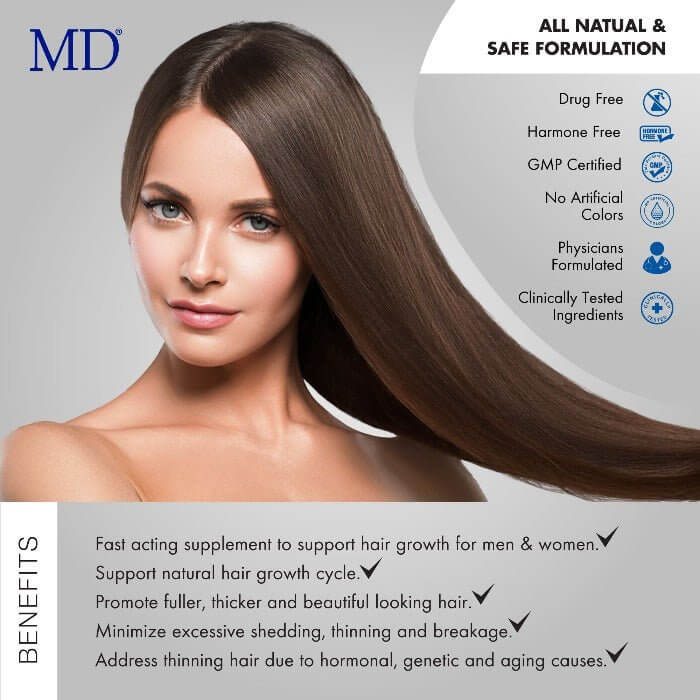
MD Nutri Hair™ is a once-daily vegetable capsule that delivers biotin at a clinically meaningful supplemental dose alongside coordinated multi-pathway inputs:
- Type I + Type III marine collagen — hydrolyzed from wild-caught Norwegian whitefish, supporting the connective tissue around the follicle
- Biotin — calibrated dose, not a megadose
- Lilac stem-cell extract — cytokine-modulating signaling pathway
- Flax seed lignans — naturally derived phytoestrogens supporting hormonal balance
- Targeted botanicals — connective tissue between traditional herbal hair-support traditions and modern cosmetic-pharmaceutical science
Manufactured in the USA in an FDA-registered, GMP-compliant facility that produces food, cosmetics, and dietary supplements under one roof. Naturally derived ingredients, no artificial colors or flavors — each batch may show slight color variation, which is plant material variation honestly reflected in the capsule rather than masked with synthetic colorants.
Frequently asked questions
Do I need a biotin supplement for hair?
Most adults eating a varied diet are not deficient. Marginal status is more common in postpartum, peri-menopausal, malabsorption, or restricted-diet users — these benefit from a calibrated multi-pathway formula like MD Nutri Hair, not a megadose single-ingredient pill.
How much biotin should I take per day?
Reference intake is 30 mcg. Clinically meaningful supplemental dose for hair support: 300-1,000 mcg as part of a multi-pathway formula. Megadose (5,000-10,000 mcg) has no proven added benefit and interferes with laboratory tests.
Can I get enough biotin from food?
Yes — eggs, salmon, nuts, seeds, sweet potatoes, organ meats, and many vegetables provide biotin. Most varied diets meet the 30 mcg adequate intake without supplementation.
Does topical biotin work?
Topical biotin has minor surface conditioning effects but does not deliver to the follicle where biotin biology happens. Oral is the more biologically appropriate route.
Is biotin safe during pregnancy?
Reference intake is similar for pregnancy. Megadose biotin should be avoided in pregnancy and breastfeeding without physician guidance.
What is MD Nutri Hair?
The inside-out nutritional supplement of the MD Hair™ system — marine collagen, calibrated biotin, lilac stem-cell extract, flax seed lignans, and botanicals in a once-daily capsule. Made in the USA in an FDA-registered, GMP-compliant facility.
About the Author
Susan F. Lin, M.D. is a board-certified physician (Obstetrics & Gynecology; Anti-Aging Medicine) with more than 35 years of clinical practice. She is the creator of the MD® family of physician-formulated brands — MD Hair™, MD Lash Factor®, MD Skin™, MD Wellness™ — and the inventor on an international patent portfolio (US, China, Hong Kong, Korea, WIPO) covering hair-growth compositions. Her research has been published in Euro Cosmetics, The National Hair & Skin Journal, and The Link — American Hair Loss Council; she is a contributing author to Harry’s Cosmeticology, 9th Edition.
Related reading
- Does Biotin Really Help Hair Growth? — A Physician’s Guide to Biotin, Keratin, and MD Hair™
- Does Marine Collagen Help Hair Growth? — MD Nutri Hair™
- What Is MD Hair™? A Physician’s Guide
- How Does the Hair Growth Cycle Work?
- MD Hair Clinical Evidence Dossier
Featured product
- MD Nutri Hair™ — Multi-pathway inside-out support: Type I + III marine collagen (wild-caught Norwegian whitefish), calibrated biotin, lilac stem-cell extract, flax seed lignans, botanicals. Made in the USA in an FDA-registered, GMP-compliant facility. Sold at md-factor.com and mdhair.com.
Educational only; not a substitute for individualized medical advice. Information about biotin and laboratory test interference is summarized from FDA public safety communications. If you are pregnant, nursing, taking medications, or have a known medical condition, consult your physician before starting any new supplement.